FTC Opens Probe of Leading AI Labs: What It Means for Property Managers

The Federal Trade Commission (FTC) is investigating OpenAI, Anthropic, and other leading artificial intelligence (AI) companies. An agency spokesperson confirmed the probe on September 30, 2026. The FTC wants to know whether these companies’ products put consumers at risk.

Most property managers don’t build AI. But many use it every day, from leasing chatbots to listing tools to features built into property management software. The FTC is also the agency weighing new rules on rental fees. How it approaches AI says a lot about how it may view the businesses that use these tools.

What the FTC Is Doing

The FTC is reviewing whether the companies’ conduct breaks the FTC Act. That law bars unfair or deceptive business practices and protects fair competition. Anthropic and OpenAI are the only firms named so far. The spokesperson declined to identify the others.

According to the New York Post, which first reported the story, Chairman Andrew Ferguson is preparing civil investigative demands. These work much like subpoenas. They can require companies to hand over records and have executives testify about the safety of their models. A senior FTC official said Ferguson opened the investigation a few weeks earlier and that the demands should go out in the coming weeks.

What This Is Not

An investigation is not a charge. The FTC has not accused any company of breaking the law, and it has not released a complaint or the text of its demands. It is also not a new rule and not an order to stop building AI. As one official put it, the agency is not telling the companies to stop and is in the investigative phase.

This probe is different from the FTC’s September 2025 inquiry into AI companion chatbots. That earlier effort was a study of seven companies, focused on risks for children and teens. The FTC said it had no specific law enforcement purpose, and Anthropic was not on that original list. The new matter is an investigation, which could lead to enforcement if the agency finds evidence of a violation.

Chairman Ferguson’s Approach

Ferguson has staked out a two-sided position. He wants the U.S. to keep its lead in AI. But he also expects AI companies to follow the laws already on the books.

He has been skeptical of calls for sweeping new AI rules. He recently said some AI firms are trying to alarm the public into backing regulations that would create a “moat” against smaller competitors. In a recent Reuters interview, he indicated that developers who instruct AI agents would be liable for harm that those agents cause. In short, he does not accept “the AI did it” as an excuse.

The timing is notable. The probe became public one day after leaders from major AI companies signed a voluntary safety pledge at the White House.

Why It Matters for Property Managers

This investigation targets AI developers, not the businesses that use their products. Still, the thinking behind it is worth watching. If the people who build and direct an AI tool are responsible for what it does, that idea could reach the businesses that put those tools to work.

For property managers, the takeaway is simple: using AI does not shift your responsibility. If a leasing chatbot quotes the wrong fees, makes a promise you can’t keep, or gives a prospect inaccurate information, regulators are likely to see that as your company’s statement. The same goes for listing ads, tenant notices, and screening decisions shaped by AI. Fair housing, fee disclosure, and consumer protection laws all still apply.

AI agents raise the risk. These tools can act on their own, such as scheduling showings, sending messages, or moving data between systems. Recent reports of AI agents reaching systems they were never authorized to access are a reminder that oversight matters.

Practical Steps for Members

None of this calls for panic. It does call for good habits. Start by knowing which AI tools your company uses, including features built into the software you already pay for. Then spot-check what those tools say to residents and prospects, especially about fees, availability, and eligibility.

Keep a person involved in decisions that affect people’s housing, such as approvals, denials, and notices. Be careful not to overstate what AI does in your own marketing. Finally, ask your vendors how they test their tools, what safeguards they use, and how they handle resident data. Their answers belong in your contracts.

What Comes Next

FTC investigations often take months. This one could end with no action, a settlement, or a formal case. Much is still unknown, including which other companies are involved and what questions the FTC will ask.

NARPM’s advocacy team will keep watching this probe alongside our ongoing work with the FTC on rental fee rules and with Congress on federal AI policy. We’ll share updates as soon as they come.

In the meantime, this post is for general information only and is not legal advice. Before changing how your company uses AI, talk with a qualified attorney who knows the laws in your state, or check out the NARPM Legal Hotline.
AI Is Now “Super Intelligence” in Washington. Here’s What That Means for Property Managers

On September 29, President Trump signed an executive order and joined leading tech companies in signing a voluntary pledge on artificial intelligence. If you saw the headlines and wondered what changes for your business, the short answer is: nothing right now. Here is what each action does and does not do.

The executive order: a name change

The order tells federal agencies to use the terms “Super Intelligence” and “SI” instead of “artificial intelligence” and “AI” in their own communications and documents. That is the core of it.

  • It applies to the executive branch only. It does not regulate private businesses.
  • It does not change existing laws, regulations, or contracts.
  • For now, “Super Intelligence” means the same thing the law already calls artificial intelligence.

One piece is worth watching. Within 60 days, the White House science adviser must send the President proposed legislative language to define “Super Intelligence.” That could shape how future laws describe and cover these technologies. Because Congress writes the laws, any new definition would need to go through Congress.

The accord: a voluntary pledge

The White House Accord on Super Intelligence was signed by Google, Anthropic, Meta, OpenAI, xAI, and Nvidia. It asks companies that build the most advanced AI models to use internal safety controls, assign an internal team to oversee them, work with an independent outside auditor, and set up a board committee to review the results.

It is a statement of principles, not a law. It has no enforcement mechanism, and it applies to a small group of developers, not to companies that use AI tools. The pledge itself says codifying these steps into law “may make sense” someday. Any such law would have to pass Congress first.

What this does not do for you

  • It creates no new compliance duties for property managers.
  • It does not override state or local AI laws.
  • It does not change the rules that already apply when you use technology in screening, advertising, or resident communications. Fair housing and consumer protection laws still apply, no matter what the technology is called.

If you use AI tools in your business, keep following your state’s rules and talk to your own legal counsel before changing your practices.

NARPM is watching

NARPM Advocacy staff will keep monitoring and engaging on AI issues that affect our members, including any federal definition proposal and future legislation. As always, we will keep you informed and speak up for property managers when it matters.

Donate an item today for the 2026 NARPM PAC Convention Silent Auction!

The NARPM® PAC Silent Auction is back! It will take place at the 2026 NARPM® Annual Convention & Trade Show, October 13–15 at Mandalay Bay in Las Vegas. We are now accepting auction item donations, and we would love to include yours.

Donating Is Easy

You can donate an item online in just a few minutes. There is still time. We can accept items right up until convention begins.

You do not need to bring your item to Las Vegas. Just list it online and hold onto it. When the auction closes, we will let you know who won so you can arrange to get the item to the winner. It is that simple.

Need Some Ideas?

Great auction items include gift cards, electronics, sports or event tickets, stays at vacation homes, and themed gift baskets. Items that show off your hometown or region are always popular. Affiliate members can also consider donating products or services their company offers.

Why Your Support Matters Now

A new Congress will take office in January 2027. That means new members, new committee assignments, and new people making decisions about housing, rental policy, taxes, and technology. Many of those lawmakers will know very little about residential property management.

NARPM® PAC helps us change that. It allows NARPM® to build and keep relationships with lawmakers on both sides of the aisle, so they understand how their decisions affect property managers, owners, and residents. Those relationships take time to build, and the start of a new Congress is when they matter most. Every item donated and every bid placed helps make that work possible.

Donate an Auction Item

Questions about donating an item? Contact Tyler Craddock, NARPM® Chief Advocacy Officer, at [email protected] or (202) 918-1135.

Contributions to NARPM® PAC are not deductible as charitable contributions for federal income tax purposes.

NARPM® Urges Treasury to Clarify Treatment of Property Management Agreements

NARPM® has sent a letter to the U.S. Department of the Treasury requesting clear guidance as the agency implements the 21st Century ROAD to Housing Act (H.R. 6644).

In the letter, NARPM asks Treasury to confirm that entering into or operating under a standard property management agreement does not give a third-party property manager direct or indirect control of a single-family property for purposes of determining whether an entity is an institutional investor.

Professional property managers provide services on behalf of property owners, including maintenance coordination, resident communications and rent collection. They do not own the property, hold equity in it or make the owner’s final investment and sale decisions. Without clear guidance, properties owned by separate small housing providers could be incorrectly grouped together simply because the owners use the same professional management company.

NARPM is urging Treasury to address this issue promptly to help prevent market disruption, protect small property management businesses and preserve access to professional management services for housing providers.

Read NARPM’s letter to the U.S. Department of the Treasury

NARPM will continue to represent the interests of residential property management professionals and serve as a resource to federal policymakers as regulations are developed.

HUD Regulatory Update: Three Fair Housing and Housing Assistance Rules to Watch

NARPM® continues to monitor federal regulatory activity that may affect residential property managers, housing providers, owners and the residents they serve.

The federal government’s latest Unified Agenda includes three HUD rulemakings that are worth watching. Two are still in the early stages, while one has moved closer to a final rule.

1. Assistance Animals and Reasonable Accommodation Requests

HUD has listed a new rulemaking titled Soliciting Comments on HUD’s Regulations Related to Requests for Assistance Animals as a Reasonable Accommodation under RIN 2529-AB14.

According to the Unified Agenda, HUD plans to issue an Advance Notice of Proposed Rulemaking in October 2026. This means HUD is expected to ask for public input before drafting a formal proposed rule.

The issue is important for property managers because it may affect how housing providers evaluate requests involving assistance animals, including service animals and emotional support animals. HUD also states that, where feasible, it would like to better harmonize Fair Housing Act guidance with the Department of Justice’s Americans with Disabilities Act rules.

What happens next: NARPM will review the Advance Notice of Proposed Rulemaking when it is released and proceed based on what is proposed.

2. Fair Housing Act Requirements for Residential Real Estate-Related Transactions

HUD has also listed a rulemaking titled Clarifications of Specific Fair Housing Act Requirements Concerning Discrimination in Residential Real Estate-Related Transactions under RIN 2529-AB19.

This proposal is expected to address Fair Housing Act requirements related to residential real estate-related transactions, including the proper scope of redlining and appraisal-bias enforcement. HUD states that the rule is expected to include examples of prohibited and permitted conduct. We addressed this in an earlier post. 

The Unified Agenda lists this item at the proposed rule stage, with a Notice of Proposed Rulemaking expected in October 2026.

What happens next: Once HUD releases the proposed rule, NARPM will review the details and assess how the proposal may affect residential property management practices, compliance expectations or fair housing risk for members.

3. Verification of Eligible Status in HUD Housing Programs

HUD’s proposed rule titled Housing and Community Development Act of 1980: Verification of Eligible Status is further along in the process. This rulemaking is listed under RIN 2501-AE16.

The proposal would revise HUD rules related to verification of U.S. citizenship or eligible immigration status for certain HUD-assisted housing programs. This includes programs that may matter to NARPM members who work with Housing Choice Voucher participants or other covered housing assistance programs.

The public comment period closed on April 21, 2026. HUD’s Unified Agenda now lists the rule at the final rule stage and anticipates a final rule in November 2026.

NARPM previously submitted comments to HUD on this issue, focusing on practical concerns for property managers and housing providers, including compliance timelines, operational burdens, financial risk for owners participating in voucher programs and the need for clear guidance to reduce fair housing exposure.

Read NARPM’s comment letter to HUD on the Verification of Eligible Status proposed rule.

Why This Matters for Property Managers

Federal housing rules can shape day-to-day operations for property managers. Even when a rule is aimed at public housing, voucher programs or fair housing enforcement, it can affect screening, leasing, reasonable accommodation requests, owner expectations, resident communication and compliance procedures.

At this stage, members do not need to make operational changes based only on the Unified Agenda. The Unified Agenda is a planning document, not a final regulation. However, it is an important signal of what federal agencies expect to work on in the months ahead.

NARPM will continue to monitor these rulemakings and provide updates as HUD releases additional details.


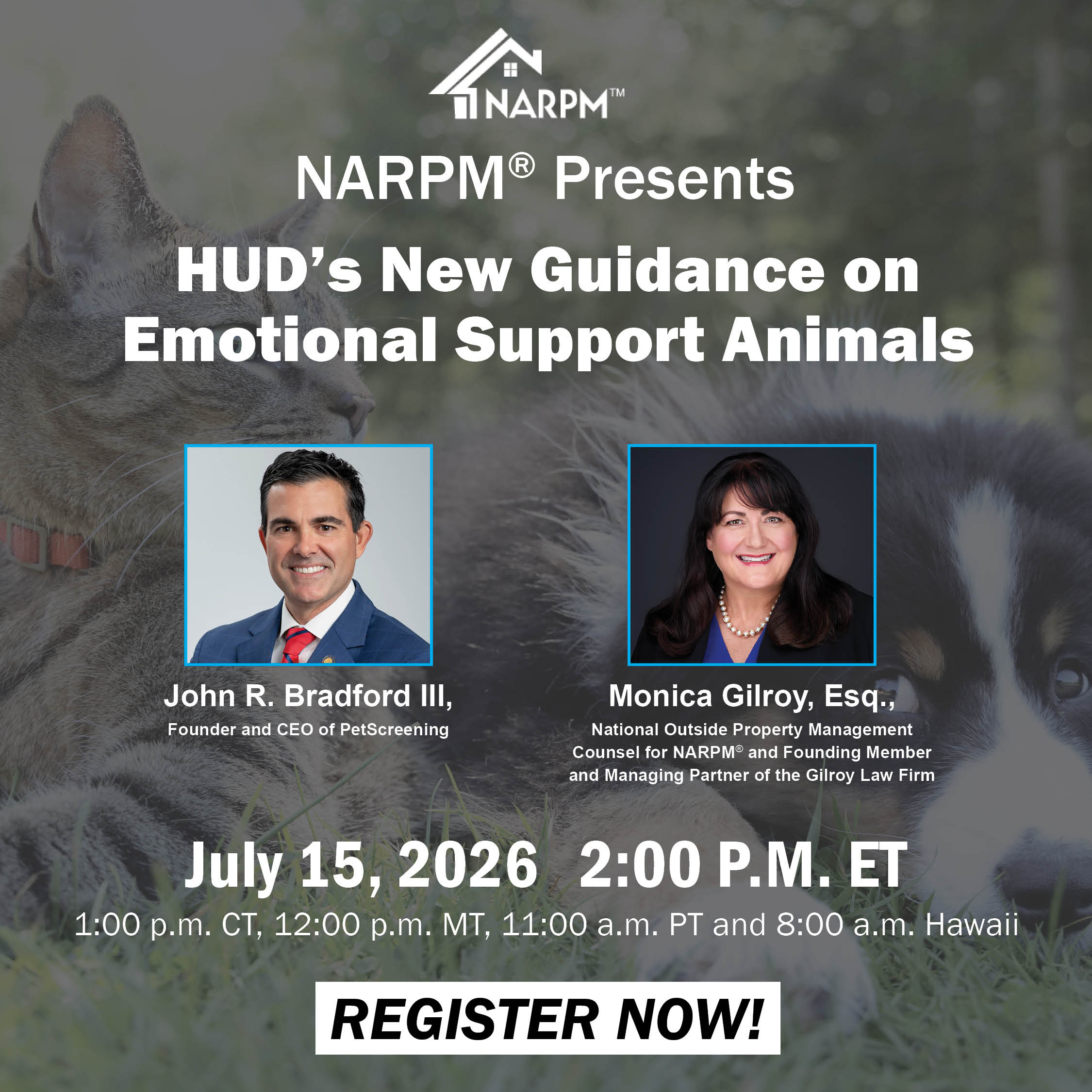
HUD Rescinds 2020 Assistance Animal Guidance: What It Means for Property Managers


The Department of Housing and Urban Development (HUD) has officially rescinded its 2020 guidance regarding assistance animals. This shift introduces critical legal and operational updates for property managers navigating reasonable accommodation requests for Emotional Support Animals (ESAs).

To help you stay compliant and ahead of these changes, NARPM® is hosting an exclusive webinar featuring top industry experts who will break down the new guidance, its immediate impacts, and best practices for your business.

Webinar Event Details

  • 📅 Date: July 15, 2026
  • ⏰ Time: 2:00 PM ET | 1:00 PM CT | 12:00 PM MT | 11:00 AM PT | 8:00 AM Hawaii
  • 🎙️ Featured Speakers:
    • John R. Bradford III – Founder and CEO of PetScreening
    • Monica Gilroy, Esq. – National Outside Property Management Counsel for NARPM® and Managing Partner of the Gilroy Law Firm
NARPM Presents: HUD's New Guidance on Emotional Support AnimalsDon’t miss this crucial regulatory update.

Now Accepting Applications: Serve as a NARPM PAC Trustee

Are you passionate about protecting the property management profession through the political process? NARPM® is looking for members who want to help steer the NARPM PAC — and applications are now open.

What Is the NARPM PAC?

The NARPM PAC is the association’s federal political action committee. PAC Trustees play a key role in guiding how the PAC operates and grows — helping ensure that NARPM’s advocacy resources are put to work for property managers and the owners they serve.

Who Can Apply?

The NARPM PAC Nominating Committee is accepting applications for seven open Trustee seats. Trustees will serve two-year terms beginning January 1, 2027. To qualify, applicants must:

  • Be a NARPM member in good standing
  • Have an active interest in the political process
  • Have no political party conflict of interest (trustees cannot hold elected or appointed leadership roles in any political party at any level)
  • Not be actively running for political office
  • Appreciate the importance of PAC engagement to NARPM’s advocacy mission

What Does the Role Involve?

Trustees commit to regularly attending PAC meetings, taking an active part in the committee’s work, and carrying out all PAC activities in a nonpartisan manner. Trustees also help encourage fellow members to participate in NARPM advocacy.

Apply by August 28, 2026

Interested members should complete the 2027 NARPM PAC Trustees Application no later than close of business on August 28, 2026. The Nominating Committee will review applications and make recommendations to the NARPM Board of Directors.

Apply Here ›

Questions? Reach out to the NARPM Advocacy at [email protected].

House Members Unveil the Great American AI Act — Here’s the Full Picture

Members who use artificial intelligence in their businesses will want to know what happened on Capitol Hill this week. On June 4, 2026, Congressman Jay Obernolte (R-CA) and Congresswoman Lori Trahan (D-MA) released a discussion draft of the Great American AI Act—a sweeping, bipartisan proposal to create a national framework for governing artificial intelligence. Four additional members of Congress from both parties co-signed. A discussion draft is not yet a formal bill; it’s released for public comment before official introduction, which means stakeholders like NARPM® have a window to help shape what the final legislation looks like.

What’s in the Great American AI Act?

The bill covers four major areas. On frontier AI governance, it targets large, powerful AI companies (those with more than $500 million in revenue) and requires them to publicly post risk-management frameworks, publish transparency reports with each new AI model release, and report serious safety incidents to a new federal agency—the Center for AI Standards and Innovation (CAISI)—housed in the Department of Commerce and funded at $100 million per year. The bill would also preempt state and local laws that specifically regulate how AI models are developed—but not how they are used or deployed—with that preemption expiring after three years.

On workforce, the bill funds AI literacy programs from K–12 through community college and creates scholarships for AI-related degree programs. It also requires employers to disclose in layoff notices whether AI was a significant factor in the job cuts. On cybersecurity and fraud, it extends the Cybersecurity Act of 2015 through 2035 and doubles the maximum penalty for AI-enabled fraud to $2 million. On research, it formally establishes the National AI Research Resource (NAIRR) in law, giving researchers and small businesses access to computing power and datasets for AI development.

Why Property Managers Should Pay Attention

AI is already part of how property management companies operate—from tenant screening and market rent analysis to lease drafting and maintenance coordination. The preemption provision could reduce the complexity of navigating different state AI rules across multiple markets, though it is important to note that it applies only to how AI models are built, not how they are used. State and federal Fair Housing, tenant screening, and privacy laws remain fully in force. The transparency requirements placed on large AI developers could also give you better information when evaluating whether the software products you use create legal exposure for your business. And stronger fraud penalties offer some protection against the growing threat of AI-generated scams targeting the rental industry.

A Related Effort: The American Leadership in AI Act

The Great American AI Act does not stand alone. Just six weeks earlier, on April 27, 2026, Congressman Ted Lieu (D-CA) and Congressman Obernolte introduced the American Leadership in AI Act—a package of more than 20 bipartisan proposals drawn from the work of the House Bipartisan AI Task Force, which the two members co-chaired last Congress. Where the Great American AI Act sets guardrails for the most powerful AI systems, the American Leadership in AI Act focuses on building America’s capacity to lead—expanding research infrastructure, modernizing federal AI adoption, and strengthening the AI workforce pipeline. Think of the two bills as complementary: one builds the guardrails, the other builds the runway.

The Full Picture: A National AI Policy Taking Shape

Both bills reflect a broader convergence in Washington. In March 2026, the Trump Administration’s National Policy Framework for Artificial Intelligence called on Congress to establish a single national AI standard, preempt conflicting state laws, and reduce barriers to AI adoption for small businesses. Before that, in 2024, the Senate’s Bipartisan AI Policy Roadmap—developed by a working group led by Senators Schumer and Rounds through nine public forums drawing more than 150 experts—set out a sweeping blueprint covering many of the same themes. Across all three frameworks, the priorities are consistent: American leadership in AI innovation, meaningful protections for workers and the public, and a single national standard over a patchwork of state rules. The debate is no longer about whether Congress will act—it’s about what the rules will say.

NARPM Is Watching

What gets decided in Washington over the next year or two will shape the tools you can use, the rules governing how you use them, and the legal risk you carry if something goes wrong. NARPM’s advocacy team is actively monitoring both the Great American AI Act and the American Leadership in AI Act, with a focus on ensuring that any new federal AI framework supports—rather than limits—your ability to use technology effectively and in compliance with Fair Housing and other legal obligations. We will keep you informed as these proposals develop. 

HUD Issues New ESA Memo

On May 22, 2026, HUD Assistant Secretary for Fair Housing and Equal Opportunity Craig Trainor issued an enforcement memorandum that changes how HUD will handle animal-related reasonable accommodation complaints under the Fair Housing Act.

Under the new standard, HUD’s Office of Fair Housing and Equal Opportunity (FHEO) will find reasonable cause and recommend charges only in cases where the animal has been individually trained to perform work or tasks directly related to the person’s disability. This standard mirrors the definition of a service animal under the Americans with Disabilities Act (ADA).

The memo also formally rescinds HUD’s 2020 guidance on emotional support animals (ESAs), known as FHEO Notice FHEO-2020-01, as well as the 2013 assistance animal notice that preceded it. Those documents had broadly extended fair housing protections to untrained ESAs and had restricted housing providers from charging pet fees in connection with accommodation requests. HUD’s memo concludes that the guidance went beyond what the Fair Housing Act requires and was never subject to the public notice-and-comment process required for binding rules.

Why It Matters for Property Managers

ESA-related complaints have grown significantly in recent years, accounting for more than 20% of FHEO’s fair housing caseload according to the memo. For property managers — particularly those managing single-family homes or small portfolios — these complaints have been a persistent source of legal exposure and operational uncertainty, especially given the widespread availability of online ESA letters from services that require little or no clinical relationship.

The new guidance means HUD will no longer pursue federal complaints based solely on a housing provider’s refusal to accommodate an untrained ESA. That is a meaningful shift in the federal enforcement posture.

At the same time, it is important to understand what this memo does not change. The Fair Housing Act itself has not been amended. Tenants and applicants retain the right to file a private lawsuit in federal or state court regardless of HUD’s enforcement priorities. And many states have their own fair housing laws that may impose different or stricter requirements than the federal standard. This memo addresses federal enforcement only.

What Comes Next

HUD has announced its intent to pursue formal notice-and-comment rulemaking to update its regulations on animal-related reasonable accommodations — a set of rules that has not been revised in 35 years. That process will give housing providers, property managers, and other stakeholders the opportunity to submit public comments before any new rules take effect.

NARPM® will monitor the rulemaking closely and plans to engage the process on behalf of members. We will provide additional guidance as that process moves forward.

Read the Memo

You can read the full enforcement memorandum from Assistant Secretary Trainor, including supporting case examples, here.

A Reminder on Legal Guidance

This memo reflects a significant shift in federal enforcement priorities, but it does not eliminate legal risk for housing providers. Fair housing law remains an area of real complexity at the federal, state, and local levels, and the legal landscape on ESAs is still evolving. NARPM® encourages members not to change their animal accommodation policies or practices based on this guidance unless directed to do so by your own qualified legal counsel.

NARPM Joins Housing Coalition Urging Congress to Repeal Pandemic-Era 30-Day Notice to Vacate

NARPM® joined 13 other national housing organizations this week in sending a letter to key House Appropriations leaders. The letter was addressed to the chair and ranking member of the full House Committee on Appropriations, as well as the chair and ranking member of the Subcommittee on Transportation, Housing and Urban Development (THUD) — the lawmakers with direct oversight of the spending bill where this fix would appear.

The coalition is asking Congress to include a key provision in the FY2027 THUD Appropriations bill that would clean up an outdated pandemic-era eviction requirement never formally removed from federal law. The fix mirrors the intent of the Respect for State Housing Laws Act, a bill that has been working through Congress to accomplish this same change through standalone legislation. The coalition is now pushing for inclusion in the appropriations bill as an additional path forward.


Some Background

When Congress passed the CARES Act in 2020, it included a 120-day eviction moratorium for federally backed and federally assisted housing. It also required housing providers to give covered residents 30 days’ notice before filing for eviction after the moratorium ended on July 24, 2020.

The moratorium has been over for years. The federal COVID-19 public health emergency has ended. But the 30-day notice language — subsection (c) of Section 4024 of the CARES Act — was never formally removed from the statute. That’s a drafting problem. It leaves an outdated federal mandate on the books, creating unnecessary confusion about what the law requires.

Striking that subsection would make clear that this emergency requirement has ended and return eviction policy to where it belongs: state and local governments.


Why This Matters for Property Managers

Eviction is always a last resort for professional property managers. Keeping units occupied and residents housed is good for everyone — residents, owners, and the broader community.

But when a tenant stops paying rent and a housing provider needs to act, clear and predictable rules matter. The CARES Act 30-day notice requirement was designed for a national emergency. That emergency is over. Leaving this language in federal law creates confusion — particularly when state and local eviction procedures already govern the process in most jurisdictions.

This ambiguity is especially hard on smaller “mom-and-pop” housing providers and affordable housing operators, who depend on rental income to maintain their properties and meet their financial obligations. Unnecessary legal uncertainty at the federal level ultimately hurts residents’ long-term housing opportunities too.


Who Signed the Letter

NARPM® was joined by 13 peer organizations representing a broad cross-section of the rental housing industry:

  • National Apartment Association (NAA)
  • National Association of Realtors® (NAR)
  • Institute of Real Estate Management (IREM®)
  • National Multifamily Housing Council (NMHC)
  • National Affordable Housing Management Association (NAHMA)
  • Council for Affordable and Rural Housing (CARH)
  • Manufactured Housing Institute (MHI)
  • National Association of Home Builders (NAHB)
  • Council of Large Public Housing Authorities (CLPHA)
  • National Association of Housing Cooperatives (NAHC)
  • National Association of Housing and Redevelopment Officials (NAHRO)
  • National Leased Housing Association (NLHA)
  • Public Housing Authority Directors Association (PHADA)

The breadth of this coalition — spanning affordable housing, conventional rentals, public housing, and manufactured housing — reflects how widely this issue affects the rental housing sector.


What Comes Next

The House Appropriations Committee is now drafting the FY2027 THUD spending bill. Including this fix in the bill text would accomplish what the Respect for State Housing Laws Act has sought to do — without waiting for standalone legislation to advance separately. The Subcommittee for Transportation, Housing and Urban Development and Related Agencies has scheduled a markup for Thursday morning 

NARPM® will continue to advocate for this change and will keep you informed as the appropriations process moves forward.